
Three hours from London, two and a half from Madrid, and no visa required for EU or UK passport holders. For a country that offers North Africa’s highest trekking peak, a slice of the Sahara Desert, some of the Atlantic’s most consistent surf breaks, and a series of medieval medinas unlike anywhere else on earth — Morocco is quietly one of the most underused adventure options available to European travellers. The cost of living is low, the climate is good from September through May, and the sheer variety of experiences packed into a single trip is difficult to match.
Here is what makes Morocco worth the flight.
The Atlas Mountains: North Africa’s Best Trekking
The High Atlas range runs across central Morocco, and at its highest point stands Jbel Toubkal — 4,167 metres, the tallest peak in North Africa and one of the most accessible high-altitude summits on the planet. No technical experience is required; what you need is solid fitness, sensible layering, and an understanding that altitude matters even here.
The classic route begins in Imlil village (1,740m), reachable in around ninety minutes from Marrakech. A licensed guide is required by Moroccan law since 2019 — expect to pay around €50–80 per day for a qualified guide, depending on group size and season. The standard two-day ascent climbs to the Neltner Refuge (3,207m) on day one, then summits early morning on day two before descending to Imlil. On a clear day the summit views stretch across the full sweep of the Atlas, south toward the pre-Saharan plains.
Beyond Toubkal, the broader Atlas offers multi-day treks through Berber villages — Aït Benhaddou, used as a film set for everything from Lawrence of Arabia to Game of Thrones, sits on the southern edge of the range. The best trekking season is April through June and September through November; avoid July and August when temperatures at altitude become serious.
The Sahara: Overnight in the Dunes
Erg Chebbi, the great dune field near Merzouga in southeastern Morocco, is around ten hours from Marrakech by road — or a short flight from Marrakech to Errachidia, then a transfer. The dunes reach up to 150 metres, the colour shifts between orange and red depending on the light, and the silence is the kind you don’t encounter in Europe.
The standard approach is a late-afternoon camel trek into the dunes, an overnight in a desert camp, and an early-morning return to watch the sunrise before the heat of the day. Organised tours from Marrakech typically run three to four days, combining the Drâa Valley, Todra Gorge, and the dunes into a single route. Budget around €50–80 per night for a mid-range camp with dinner and breakfast included.
The experience has become popular, which means the very front row of camps nearest Merzouga is busy in high season — book with a small operator who camps further into the dunes, not at the fringe of the town.
Taghazout: Atlantic Surf Within Reach
Morocco’s surf coast runs along the Atlantic, and the village of Taghazout — an hour north of Agadir — is its centre. The waves here are consistent and varied: Anchor Point is a right-hand point break suited to experienced surfers; Hash Point and La Source provide more forgiving options for beginners and intermediates. The water temperature year-round runs warmer than northern Europe, and the season effectively never ends.
Surf camps and schools have grown up around the area over the past decade. A week-long camp including accommodation, daily lessons, and equipment hire typically runs €400–700 depending on the level of comfort. Agadir is served by low-cost carriers from across Europe, making this a realistic long-weekend option as well as a full week’s trip.
The cliff-path walk north from Taghazout to Anchor Point at sunset, with the surf line visible below, is one of the better views Morocco offers. The village itself — cafés, tagines, surf shops — is pleasant without being overdeveloped.
Marrakech: The Best Introduction to the Medinas
For first-time visitors to Morocco, Marrakech is where most people start, and for good reason. Jemaa el-Fna — the vast main square in the old city — is unlike any public space in Europe: food stalls, musicians, storytellers, and a constant ambient noise that peaks at dusk. The souks surrounding it sell spices, leather goods, ceramics, and metalwork across a maze of streets that take several days to properly understand.
Two sights beyond the medina warrant dedicated time: the Majorelle Garden, a 1920s botanical garden owned by Yves Saint Laurent with electric blue buildings and a strong cactus collection (entry around 150 MAD / €14), and the Koutoubia Mosque, the 12th-century landmark visible from most of the city. A traditional hammam — Hammam El Bacha near the medina is among the most respected — costs as little as €5 for the basic experience and is worth making time for.
Fes and Chefchaouen: The Other Moroccan Cities
Fes el Bali, the old city of Fes, is one of the largest surviving medieval urban areas in the world. Walking its 9,000 streets is genuinely disorienting — the scale of the souk, the noise of the tanneries, the call to prayer echoing between centuries-old walls. The Chouara tanneries, viewed from the leather merchants’ balconies overlooking the dye pits, are among the most photographed sights in Morocco; the Medersa Bou Inania is one of the finest examples of Marinid architecture anywhere. Allow at least two full days.
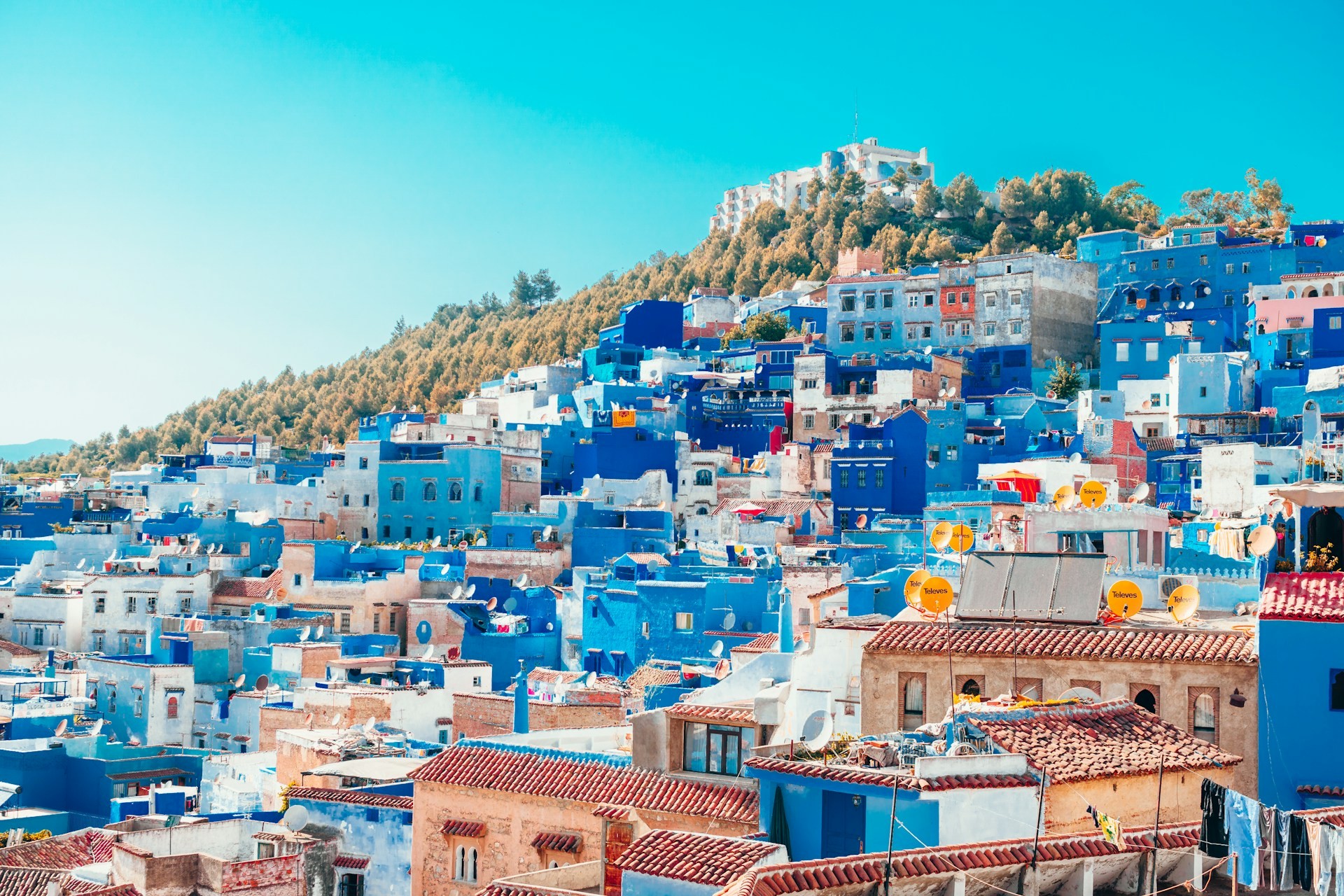
Chefchaouen, in the Rif Mountains north of Fes, is smaller and slower — a mountain town of blue-painted lanes, good hikes in the hills above the town, and cannabis fields that have made it mildly infamous. It’s worth a night or two as part of a broader northern circuit connecting Rabat, the capital, and Tétouan.
Practical Information
Getting there: Direct flights from London, Manchester, Paris, Madrid, Amsterdam, and most major European hubs to Marrakech Menara and Casablanca Mohammed V. Fares start from around £60–£100 return booked in advance; Ryanair, easyJet, and Royal Air Maroc all serve the route. Flight time from London is approximately 3 hours 20 minutes.
Visa: UK and EU citizens do not need a visa to enter Morocco. A valid passport is required. You can stay for up to 90 days.
When to go: Spring (March–May) and autumn (September–November) offer the best conditions across the country — comfortable temperatures for trekking and desert, not too hot for cities. Summer (June–August) is extremely hot in Marrakech and Fes; the Atlantic coast and mountains are more bearable.
Budget: Morocco remains affordable. Budget travellers spending carefully can manage on $30–$40 per day including accommodation, food, and local transport. Mid-range travellers spending on guided tours and riads should budget $80–$120 per day. A guided Toubkal trek for two runs approximately $150–$200 per person for a two-day ascent with guide, mule, and refuge accommodation.