
Every summer, Edinburgh draws crowds from around the world for the Edinburgh Festival Fringe, the largest arts festival on the planet. Across the UK and Europe, cities of every size now host their own fringe or fringe-style festivals, from sprawling programmes with thousands of shows to smaller, community-run line-ups spread over just a few days.
But a great fringe trip is about more than the festival programme alone. Visitors also want somewhere pleasant to explore between shows, affordable food, decent weather, and a hotel bill that doesn’t eat into the ticket budget.
To find out which destinations offer the best overall experience, Stasher assessed 17 cities across the UK and Europe with an established fringe or fringe-style festival, scoring each on the size of its programme, its comfort as a destination, and the cost of a visit.
Key findings
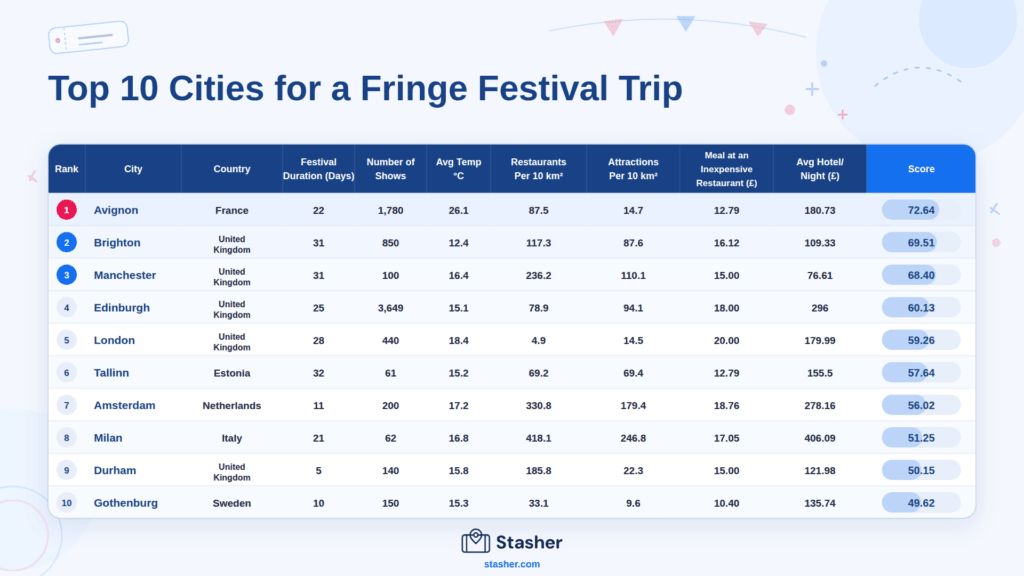
Avignon came out on top overall, with a score of 72.64. Its 22-day festival featuring around 1,780 shows was one of the largest programmes in the study, and the city also offers the cheapest meal price of the top 10 at £12.79.
The UK leads the top 10 overall, taking five of the ten places: Brighton, Manchester, Edinburgh, London and Durham. That’s more than any other country in the study, reflecting the strength and variety of the UK’s fringe scene, from major city festivals to smaller regional events.
Brighton ranked second with a score of 69.51. Its Brighton Fringe runs for 31 days, the joint-longest duration in the top 10, and the city also offers 87.6 attractions per 10 km², among the higher figures in the top 10.
Manchester placed third with a score of 68.40, helped by the cheapest average hotel rate among the top 10 destinations at £76.61 a night, alongside a strong restaurant density of 236.2 per 10 km².
Edinburgh, home to the world’s largest arts festival, ranked fourth with a score of 60.13. Its festival runs for 25 days and includes an estimated 3,649 shows, by far the largest programme in the study, though this is offset by the highest average hotel rate in the top 10, at £296 a nigh
Top performers by category
Looking beyond the overall ranking, individual cities stand out in specific areas:
- Biggest programme: Edinburgh, with an estimated 3,649 shows.
- Longest festival: Tallinn, running for 32 days, the longest of any city in the study.
- Warmest festival window: Avignon, with an average temperature of 26.1°C during the festival period.
- Highest restaurant density: Milan, with 418.1 restaurants per 10 km².
- Highest attraction density: Milan, with 246.8 attractions per 10 km², also the highest in the study.
- Cheapest meal: Prague, where an inexpensive meal costs just £8.08.
- Cheapest hotel rate: Swindon, with an average nightly rate of £50.58.
Best cities for a fringe festival trip, ranked
1. Avignon, France
Avignon takes the top spot, driven by the scale and warmth of its festival window. The Festival d’Avignon runs for 22 days and features an estimated 1,780 shows, held during an average temperature of 26.1°C, the warmest climate recorded in the entire study. Food is also affordable here, with a meal costing just £12.79.
2. Brighton, United Kingdom
Brighton Fringe offers one of the longest festival windows in the study at 31 days. The city also scores well on destination comfort, with 117.3 restaurants per 10 km², the second-highest density in the top 10, and 87.6 attractions per 10 km² to fill time between shows.
3. Manchester, United Kingdom
Manchester‘s festival runs for 31 days and stands out for its density of things to do, with 236.2 restaurants and 110.1 attractions per 10 km², both the highest figures among the top 10 destinations. Its average hotel rate of £76.61 a night is also among the more affordable options at the top of the table.
4. Edinburgh, United Kingdom
Edinburgh remains the heavyweight of the fringe world. Its 3,649 shows outnumber every other city in the study by a wide margin, and the festival runs for 25 days. That scale comes at a cost, however, with an average hotel rate of £296 a night, the highest in the top 10 and a significant factor in its lower overall score relative to its programme size.
5. London, United Kingdom
London‘s festival runs for 28 days with an estimated 440 shows. It’s a solid all-rounder on cost, with a mid-range meal price of £20.00 and hotel rate of £179.99, though it has the lowest restaurant density in the top 10 at just 4.9 per 10 km², which may make it feel less geared toward casual exploring between performances.
6. Tallinn, Estonia
Tallinn has the longest festival window of any city in the top 10, running for 32 days, and shares the joint-cheapest meal price in the study at £12.79. Its show count of 61 is modest compared with the cities above it, but its combination of low costs and a long festival run helps it hold its place in the top half of the table.
7. Amsterdam, Netherlands
Amsterdam has the shortest festival duration in the top 10 at just 11 days, but makes up for it with the destination itself, recording 330.8 restaurants and 179.4 attractions per 10 km², both the second-highest figures in the study. That comes at a cost, however, with an average hotel rate of £278.16 a night, the second-highest in the top 10.
8. Milan, Italy
Milan has the highest restaurant density in the entire study at 418.1 per 10 km², alongside 246.8 attractions per 10 km², also the highest figure recorded. It’s the most expensive city in the top 10 on both counts that matter to budget, with an average hotel rate of £406.09 a night and a meal price of £17.05, which weighs on its overall score despite its strength as a destination.
9. Durham, United Kingdom
Durham has by far the shortest festival duration in the top 10, running for just 5 days, and the second-lowest show count at 140. It remains competitive on cost, though, with an average hotel rate of £121.98 and a meal price of £15.00, both comfortably mid-table.
10. Gothenburg, Sweden
Gothenburg closes out the top 10 with the cheapest meal price in the entire study at £10.40. Its festival runs for 10 days with an estimated 150 shows, and while its restaurant and attraction density are among the lowest in the top 10, at 33.1 and 9.6 per 10 km² respectively, its affordability keeps it in the mix.
What makes a city good for a fringe trip
A fringe festival is rarely the only thing on the itinerary. Visitors want to fill the gaps between shows with good food, sightseeing, and a comfortable place to stay, without the trip becoming unexpectedly expensive.
That’s why this ranking looks beyond festival size alone. A huge programme is only part of the picture if hotel prices are high or there’s little else nearby to do. Equally, a smaller festival in a walkable, affordable city with plenty of restaurants and attractions can offer better overall value for a short break.
How to plan a fringe festival trip
- Check the festival dates against the weather. Fringe festivals run at different times of year and average temperatures can vary widely by destination, so check the forecast before you pack or book anything.
- Factor in accommodation early. Hotel rates tend to spike during festival dates, especially in smaller cities where fringe events can sell out most of the town’s rooms. Booking well ahead usually means better prices and more choice.
- Look beyond the show schedule. A destination with plenty of restaurants and attractions nearby can make the days between performances just as enjoyable as the shows themselves, so it’s worth researching what else the city has to offer.
- Balance programme size with budget. A bigger festival means more choice, but it often comes with higher costs and bigger crowds. A smaller, lower-cost festival can still deliver a great trip, especially if you’re prioritising value over volume.
Methodology
To identify the best cities for a fringe festival trip, we assessed 17 cities across the UK and Europe with an established fringe or fringe-style festival, scoring each across seven metrics that reflect the quality of the festival experience, the comfort of the destination, and the cost of attending. Cities were selected based on the presence of an established fringe or fringe-style festival, regardless of scale.
This means the dataset spans events of significantly different sizes, from the Edinburgh Festival Fringe, the world’s largest arts festival, to smaller community-focused events such as Copenhagen’s CTC Fringe and Swindon’s Old Town Arts Fringe. The ranking is therefore best read as a guide to the overall destination experience rather than a like-for-like festival comparison.
The metrics are weighted as follows:
- Number of shows (30%)
- Festival duration (20%)
- Average price of a meal at an inexpensive restaurant (12%)
- Average nightly hotel rate during the festival window (12%)
- Average temperature during the festival window (10%)
- Restaurants per 10 km² (8%)
- Attractions per 10 km² (8%)
Data is from official festival websites, Open-Meteo ERA5 archive API, Numbeo, Tripadvisor, and Momondo. For average temperature, we calculated a six-year historical average (2019 to 2024) of daily mean temperatures of each city’s festival dates.
All seven metrics are percent-ranked to get the final ranking score. Five metrics (number of shows, festival duration, average temperature, restaurants per 10 km², and attractions per 10 km²) are scored directly, so higher values receive higher scores. The two cost metrics (meal price and average hotel rate) are reverse-scored, so lower costs receive higher scores, reflecting better value for the visitor.
Official show counts are estimates based on figures published by festival organisers at the time of research (July 2026) and may represent pre-announced programme totals rather than final confirmed numbers, particularly for festivals yet to open or currently running. Festivals that had already concluded by the research date carry confirmed or near-final figures.
Average temperature during the festival window reflects the warmth of the destination during the festival period. A higher score indicates warmer conditions more associated with a classic summer festival experience.
Hotel and meal prices are date-sensitive and reflect figures collected at the time of research (July 2026). Actual costs may vary depending on when bookings are made.