
Tunisia sits two and a half hours from London, closer than most Mediterranean resorts, and contains: one of the world’s great collections of Roman mosaics, a UNESCO-listed medina that most European visitors have never walked through, a blue-and-white cliffside village that has been drawing artists for over a century, the third-largest Roman amphitheatre ever built, an island you reach by a thirty-minute car ferry, and a landscape that served as a location for the original Star Wars. It costs significantly less than southern Europe, requires no visa for EU or UK passport holders, and receives a fraction of the tourist numbers that its comparable attractions in Italy, Spain, or Greece attract.
The most honest explanation for why it remains underrated is a combination of reputation lag from the mid-2010s — when two terrorist attacks struck tourist sites in 2015 — and the general tendency of British and northern European travellers to stick with what they know. The main tourist areas today are well-established, the infrastructure is sound, and the experience of visiting is, for most people who go, a genuine surprise.
Tunis: The Medina and the Bardo
The Medina of Tunis is a UNESCO World Heritage Site and one of the most intact medieval Arab city centres in the world. It is free to enter. The souk network covers a vast area of lanes divided by trade — there are separate passages for perfume merchants, bookbinders, tailors, jewellers — and at its centre sit the Great Mosque of Ezzitouna and a series of 13th- and 14th-century madrasas with carved stonework that rivals anything in Andalusia. Unlike the medinas of Marrakech or Fes, Tunis sees modest international tourist traffic, which means you can walk streets that are genuinely used by the city rather than orientated around visitors.
The Bardo National Museum, in a former 19th-century palace in the western suburbs of Tunis, holds the largest collection of ancient Roman mosaics in the world. Entry costs around 11 Tunisian Dinars (approximately €3). The collection runs across dozens of rooms — mythological scenes, hunting tableaux, marine motifs — recovered from the villa complexes and bathhouses of Roman Africa. It is one of the most significant ancient art collections on the Mediterranean and almost entirely overlooked by the standard European museum circuit.
Sidi Bou Said and Carthage
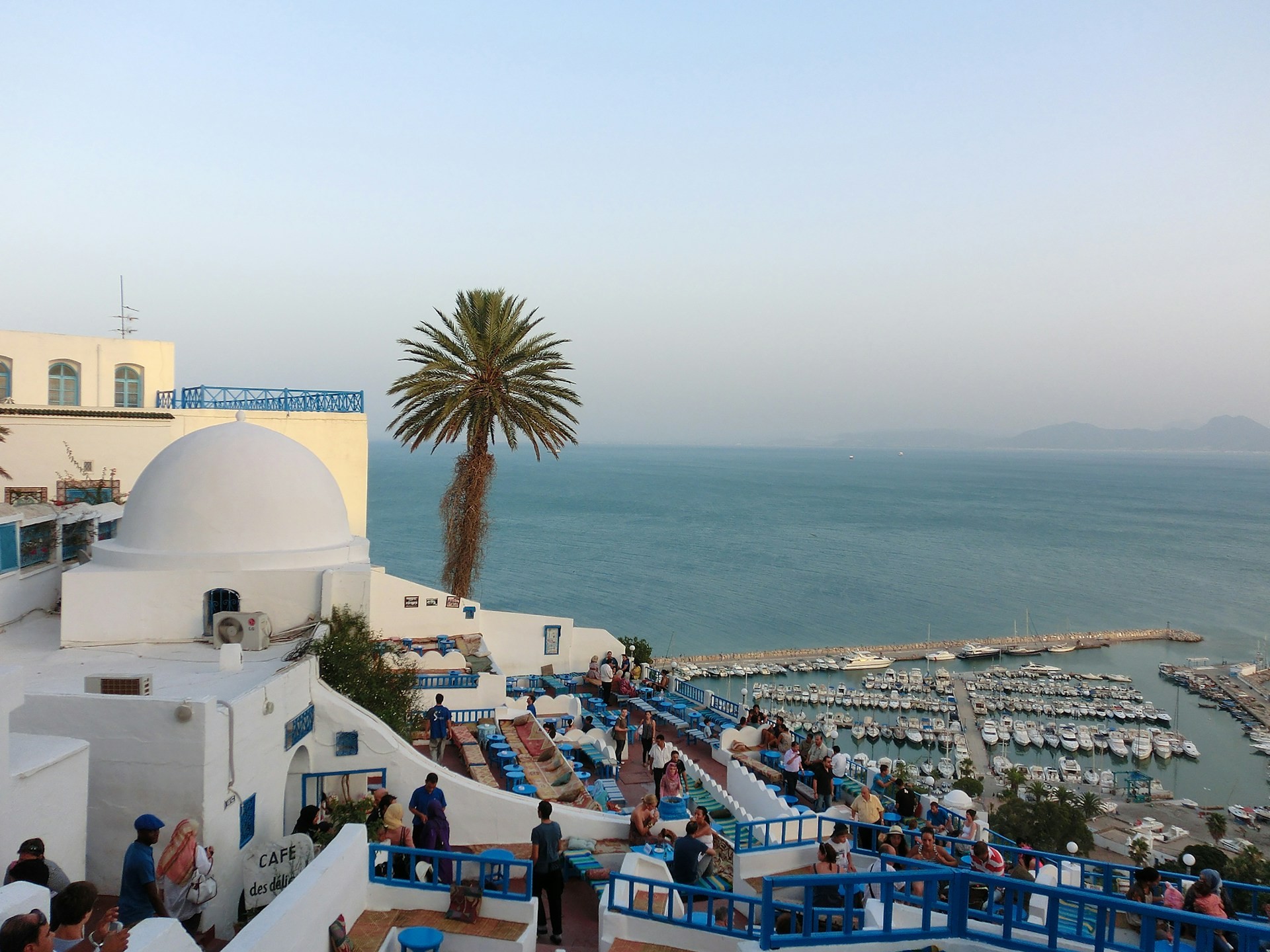
Twenty kilometres north of Tunis, a commuter train line runs along the Gulf of Tunis to Carthage and then Sidi Bou Said — one of the more useful pieces of public transport planning in the region. The village of Sidi Bou Said sits on a cliff 130 metres above the sea: white-rendered houses with blue-painted doors and shutters, bougainvillea cascading over walls, a central café (Café des Nattes) that has been operating in the same location since at least the early 20th century. Paul Klee painted here in 1914. The view across the Gulf of Tunis to the east is among the finer Mediterranean coastal panoramas that exist.
Carthage, three stops before Sidi Bou Said on the same train line, was first a Phoenician city-state that controlled much of the western Mediterranean, then a Roman provincial capital. The ruins — spread across several separate sites including the Tophet, the Punic ports, the Baths of Antoninus (the largest Roman baths in Africa), and the Byrsa Hill museum — are not contained in a single fenced enclosure, which means you walk between them through residential streets. A combined ticket covering the main sites costs around 12,000 Tunisian Dinars (approximately €4).
The Bardo’s Secret Competition: El Djem
Three hours south of Tunis by train, the town of El Djem contains an amphitheatre built by the Romans in the 3rd century AD that once seated 35,000 spectators. It is the third-largest Roman amphitheatre ever constructed — larger than the Colosseum in Rome, better preserved than the one in Capua. It stands in the middle of a small modern town with barely any context around it; you turn a corner and it is simply there, at full scale, surrounded by ordinary Tunisian streets.
Entry costs approximately €4, which also covers the adjacent Archaeological Museum housing floor mosaics recovered from nearby Roman villas. The amphitheatre is substantially less visited than comparable Roman sites in Italy or France, which means on most days you can walk the interior corridors and the upper tiers with a level of quiet that is simply not available in Rome. It is one of the genuinely underplayed monuments of the ancient world.
Djerba: The Island in the South
Djerba is an island off the southeast coast, connected to the mainland by a causeway and by a short car ferry from El Jorf to Ajim (roughly thirty minutes, running hourly, negligible cost). It has a distinct character from the Tunisian mainland: flatter, quieter, with whitewashed village architecture, traditional craftwork in silver and cloth, and a Jewish community — the El Ghriba synagogue, one of the oldest in Africa — that has been on the island for over two thousand years.
The beaches on the northeast coast are clean and long; the water in summer is clear and shallow. Houmt Souk, the main town, has a covered souk, a 15th-century fort (Borj el Kebir), and a cluster of seafood restaurants that stay busy well into the evening. Djerba is served directly by several low-cost European carriers, including from Paris, Marseille, Lyon, and various German cities, making it viable as a standalone beach-and-culture trip rather than a stopover.
Matmata and the Star Wars Locations
In the hills south of Gabès, the Berber village of Matmata is built partly underground — troglodyte dwellings carved into the soft rock to keep cool, arranged around circular open courtyards. It is the landscape that George Lucas used in 1976 as the interior of Luke Skywalker’s home on Tatooine. The Hotel Sidi Driss, where the interior scenes were shot, still operates and is still decorated with the original set dressing. The surrounding landscape — craters and rocky plateau — contributed to the name Tatooine itself, derived from the nearby town of Tataouine.
The Star Wars connection has given Matmata a modest niche tourism, but the troglodyte villages are genuinely interesting independently of the films — a form of architecture that exists almost nowhere else in the world and represents a direct response to an extreme climate developed over centuries.
Practical Information
Getting there: Direct flights to Tunis-Carthage International from London (Heathrow and Gatwick), Paris, Amsterdam, Rome, and several other European hubs. Djerba has its own airport with direct budget routes from France and Germany. Flight time from London is approximately 2 hours 40 minutes to Tunis. Carriers include Tunisair, Transavia, Nouvelair, and Vueling.
Entry requirements: EU and UK citizens do not need a visa to enter Tunisia and may stay for up to 90 days. Since January 2025, a valid passport is required — national identity cards are no longer accepted. Your passport should have at least three months’ validity remaining from your entry date.
Safety: The main tourist areas — Tunis, Sidi Bou Said, Carthage, Sousse, Hammamet, Djerba, the sites along the central coast — are well-frequented and present no unusual concerns. The UK’s Foreign, Commonwealth & Development Office advises against travel to areas within 20km of the Tunisia-Algeria border in the northwest (Jendouba and El Kef governorates) and to Kasserine Governorate. These areas are remote from the primary tourist circuit and not relevant to a standard itinerary.
Budget: Tunisia is one of the more affordable Mediterranean destinations. A mid-range hotel in Tunis costs €40–70 per night; a restaurant meal with wine runs €10–15 per person; coffee in a café is under €1. Entrance fees for most historical sites are in the €2–5 range. A well-structured week including flights, accommodation, and all activities can be done comfortably for £700–£900 per person.