


- Why a Cheap Offer Can Become Expensive
- Common Car Rental Fees in Cyprus
- Insurance and the Excess
- Security Deposit and Payment Card Rules
- Airport and Out-of-Hours Charges
- Fuel Policy
- Mileage Limits
- Additional Drivers and Age Surcharges
- Child Seats and Other Extras
- One-Way Rentals
- Road and Territorial Restrictions
- Cleaning, Smoking and Interior Damage
- Traffic Fines and Administration Charges
- Late Returns
- Damage Disputes
- Booking Through a Broker
- Common Booking Mistakes
- What to Check Before Booking
- What to Do About an Unexpected Charge
- Final Thoughts
Renting a car is one of the easiest ways to explore Cyprus. The island’s main cities are connected by good roads, while many beaches, villages, archaeological sites and mountain routes are difficult to reach by public transport. A rental car gives travelers more freedom, but the lowest price shown online is not always the final amount paid.
Insurance upgrades, deposits, fuel charges, airport fees and optional extras can significantly increase the total cost. To avoid unpleasant surprises, travelers should compare full rental conditions rather than only the advertised daily rate.
Travelers who want to review available car rental options before arriving on the island can check the booking conditions offered by Getmancar.
Why a Cheap Offer Can Become Expensive
A car advertised for €15 or €20 per day may appear attractive, but the headline price often covers only the basic rental. Taxes, insurance, airport collection, equipment and mandatory service charges may be added later.
A slightly more expensive offer can provide better value if it includes clear insurance terms, unlimited mileage and a full-to-full fuel policy. Before paying, check the final price and confirm which charges are already included.
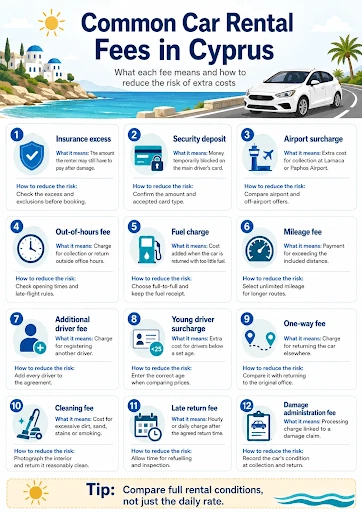
Common Car Rental Fees in Cyprus
| Fee or condition | What it means | How to reduce the risk |
| Insurance excess | The amount the renter may still have to pay after damage | Check the excess and exclusions before booking |
| Security deposit | Money temporarily blocked on the main driver’s card | Confirm the amount and accepted card type |
| Airport surcharge | Extra cost for collection at Larnaca or Paphos Airport | Compare airport and off-airport offers |
| Out-of-hours fee | Charge for collection or return outside office hours | Check opening times and late-flight rules |
| Fuel charge | Cost added when the car is returned with too little fuel | Choose full-to-full and keep the fuel receipt |
| Mileage fee | Payment for exceeding the included distance | Select unlimited mileage for longer routes |
| Additional driver fee | Charge for registering another driver | Add every driver to the agreement |
| Young driver surcharge | Extra cost for drivers below a set age | Enter the correct age when comparing prices |
| One-way fee | Charge for returning the car elsewhere | Compare it with returning to the original office |
| Cleaning fee | Cost for excessive dirt, sand, stains or smoking | Photograph the interior and return it reasonably clean |
| Late return fee | Hourly or daily charge after the agreed return time | Allow time for refuelling and inspection |
| Damage administration fee | Processing charge linked to a damage claim | Record the car’s condition at collection and return |
Insurance and the Excess
Many Cyprus rentals include a Collision Damage Waiver, usually called CDW. This does not necessarily mean complete protection. The agreement may still contain an excess: the maximum amount the renter can be required to pay if the car is damaged.
For example, if the excess is €1,000, the customer may remain responsible for up to that amount. Rental companies often offer additional coverage that reduces or removes the excess, but this increases the total price.
Insurance may also exclude damage to tyres, wheels, windows, mirrors, the roof, the underside of the vehicle and the interior. Lost keys, incorrect refuelling, careless driving and use on restricted roads may also fall outside the coverage.
Read the exclusions carefully and confirm what must be done after an accident. Failure to contact the police or rental company correctly can affect the claim.
Security Deposit and Payment Card Rules
The security deposit is usually blocked on the main driver’s card when the vehicle is collected. It is different from the insurance excess, although the amounts may be similar.
A frequent mistake is arriving with a debit card when the provider requires a credit card. Another problem occurs when the card belongs to a passenger rather than the main driver. In such cases, the company may refuse to release the vehicle or require more expensive insurance.
Before booking, confirm the deposit amount, accepted card types, required credit limit and estimated release time. Make sure the card has enough available funds for both the deposit and normal travel expenses.
Airport and Out-of-Hours Charges
Collecting a car at Larnaca or Paphos Airport is convenient, but airport rental prices may include a location surcharge. Some companies operate directly inside the terminal, while others use a shuttle or meet-and-greet service.
Check the exact collection point before arrival. A cheaper off-airport offer may be less convenient if the traveler must wait for transport or travel to another location.
Late-night collection can also cost more. Some providers charge an out-of-hours fee after a set time. Add the correct flight number to the booking and check what happens if the flight is delayed.
Fuel Policy
The fuel policy can noticeably change the final cost. Full-to-full is usually the clearest option: the customer receives the car with a full tank and returns it full.
Under a prepaid or full-to-empty policy, the renter pays for fuel in advance. The price may be higher than at local filling stations, and unused fuel may not be refunded.
If the car is returned with less fuel than required, the provider may charge both for the missing fuel and for refuelling service. Photograph the fuel gauge at collection and return, and keep the final receipt.
Mileage Limits
Many offers include unlimited mileage, but this should always be verified. A cheaper tariff may allow only a limited number of kilometres per day or per rental.
Mileage restrictions can become expensive for travelers planning to drive between Larnaca, Limassol, Paphos, Nicosia, Ayia Napa and the Troodos Mountains. Estimate the route in advance and compare the price of unlimited mileage with possible excess-kilometre charges.
Additional Drivers and Age Surcharges
Only people named in the rental agreement should drive the vehicle. Allowing an unregistered person to drive may invalidate the insurance.
Adding another driver can involve a daily or fixed fee. Some packages include one additional driver, but the name still needs to be added to the contract.
Young drivers may face extra charges or restrictions on certain vehicle categories. Some companies also apply special conditions to senior drivers. Always enter the correct age during booking so that the displayed price reflects the real conditions.
Child Seats and Other Extras
Child seats, booster seats, navigation devices and other equipment are usually charged separately. For longer rentals, these extras can add a considerable amount to the total.
Reserve essential equipment in advance, especially during summer. Check the condition and installation of a child seat before leaving the rental location. The driver remains responsible for using it correctly.
One-Way Rentals
Collecting a car at one location and returning it elsewhere can be convenient. For example, a traveler may collect a vehicle at Larnaca Airport and return it near Paphos Airport.
The rental company may charge a one-way fee because the car has to be relocated. This fee may appear only after the return location is selected. Compare it with the time and fuel required to return the vehicle to the original office.
Road and Territorial Restrictions
Rental agreements may prohibit driving on unpaved roads, beaches, mountain tracks or other unsuitable surfaces. Damage and recovery costs from restricted roads may not be covered.
Cyprus also has a special territorial situation. Travelers planning to drive outside the area controlled by the Republic of Cyprus should ask the provider whether the journey is allowed and whether the insurance remains valid. Written confirmation is safer than a verbal promise.
Cleaning, Smoking and Interior Damage
Normal use should not lead to a cleaning fee, but companies may charge for excessive sand, mud, stains, food waste or strong smells. Smoking is generally prohibited and can result in an additional cleaning or deodorising charge.
Beach trips make sand especially common. Shake out towels and bags before placing them inside the vehicle. Photograph the interior at collection if it already has stains, scratches or other damage.
Traffic Fines and Administration Charges
The driver is responsible for parking and traffic violations. The rental company may also charge an administration fee for identifying the renter and forwarding their details to the authorities.
This fee normally does not replace the original fine. The penalty may still need to be paid separately.
Traffic in Cyprus moves on the left. Drivers accustomed to right-hand traffic should be especially careful at roundabouts, junctions, petrol stations and car parks.
Late Returns
Returning the car slightly late can lead to an extra hourly charge or even another full rental day. Do not assume that every provider offers a grace period.
Allow enough time for refuelling, reaching the return location and completing the inspection. If a delay is unavoidable, contact the company before the agreed return time. Extending the booking in advance may be cheaper than a late-return penalty.
Damage Disputes
Failing to document the car’s condition is one of the most expensive booking mistakes. Inspect the bodywork, wheels, windows, mirrors, roof and interior before driving away.
Compare all visible marks with the damage report. Take clear photographs and a continuous video showing every side of the car, the mileage and fuel level.
Repeat the process at return. When possible, ask an employee to inspect the vehicle and provide written confirmation that no new damage was found. Keep the agreement, photographs, fuel receipt and return documents until the deposit has been released.
Booking Through a Broker
Comparison websites can help travelers find lower prices, but the broker accepting the reservation may not be the company supplying the vehicle.
This can create confusion because the broker’s conditions and the local provider’s rules may differ. Insurance purchased from an intermediary may work as reimbursement coverage. The rental company can still block a deposit or charge for damage, after which the customer must submit a separate claim.
Before paying, identify the actual vehicle provider and read both sets of terms.
Common Booking Mistakes
The most common mistakes are choosing an offer only by its daily price, ignoring the excess, arriving without the correct card, overlooking the fuel policy and failing to photograph existing damage.
Other risks include allowing an unregistered driver to use the car, returning it late, exceeding the mileage limit, driving on prohibited roads and discarding documents before the deposit is released.
What to Check Before Booking
Before entering payment details, verify:
- the final price;
- insurance coverage and excess;
- deposit and card requirements;
- mileage and fuel policies;
- airport and out-of-hours fees;
- additional driver and equipment costs;
- cancellation and return conditions.
A transparent offer should make the realistic cost clear before the traveler arrives at the rental desk.
What to Do About an Unexpected Charge
Contact the rental company in writing and request an itemised explanation. Attach the booking confirmation, rental agreement, photographs, receipts and return documents.
Keep communication factual and refer to the specific condition you believe was applied incorrectly. If the matter cannot be resolved directly, a traveler may seek assistance from an appropriate consumer protection body or payment provider.
Final Thoughts
Car rental in Cyprus can make a trip far more flexible, especially when visiting beaches, villages and mountain areas outside the main resorts.
The safest approach is to compare full conditions rather than headline prices. Check insurance, deposits, fuel, mileage and location fees before booking. At collection and return, document the vehicle carefully.
A transparent offer may not have the lowest advertised daily rate, but it can provide better value and reduce the risk of unexpected charges.