

- The short answer
- Pet passports are gone for British dogs
- What every dog needs before travelling
- Getting there: the three routes that actually work
- A note on luggage
- Country by country: what UK owners need to know
- France
- Spain
- Germany
- Italy
- The Netherlands and Belgium
- Ireland (Republic)
- Norway, Malta and Finland
- Switzerland
- Beyond Europe
- Coming home is the bit that goes wrong
- Insurance: what UK policies actually cover abroad
- The essentials checklist
- The honest read on travel stress
- Quick comparison: where the breed laws are strictest
- The straightforward case for proper planning
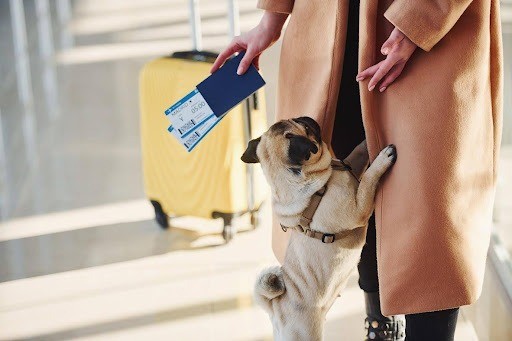
Taking a dog across the Channel from the UK is no longer the simple process it was a few years ago. The pet passport system that British owners relied on for two decades was replaced after Brexit, and the new framework is more administrative, more time-sensitive, and considerably easier to get wrong.
It is still very possible. UK owners take dogs to France, Spain, Italy, the Netherlands, and beyond every week of the year.
But the rules now require deliberate planning, the right paperwork in the right order, and a working understanding of which European countries take a relaxed view of larger dogs and which absolutely do not.
This guide walks through every stage of the process for owners travelling from Great Britain, including what each country requires on arrival, how the return journey actually works, and what UK pet insurance typically does and does not cover overseas.
The short answer
Yes, dogs can travel abroad from the UK. For trips into the EU, an Animal Health Certificate (AHC) is required for each individual trip, the dog must be microchipped, and the rabies vaccination must have been administered at least 21 days before the date of travel.
Preparation takes around two weeks at a minimum, and vet fees for the AHC typically range from £150 to £300 depending on the practice. The certificate covers a single outbound entry into the EU, up to four months of onward travel within the bloc, and the return journey back to Great Britain.
Pet passports are gone for British dogs
The pet passport scheme that allowed UK dogs to travel across Europe on a single, reusable document ended on 1 January 2021. GB-issued pet passports are no longer valid for entry into the EU.
What replaced it is the Animal Health Certificate, and unlike the passport, a new one is required for every single trip. This is the most common point of confusion for owners who travelled with their dogs before Brexit.
Northern Ireland is the exception. NI-issued pet passports remain valid under the Northern Ireland Protocol, and owners based in Northern Ireland can continue to travel into the EU under the older system.
What every dog needs before travelling
The baseline requirements are straightforward, but the sequence is important.
The dog must be microchipped first. The chip needs to be implanted and registered before the rabies vaccination, because the vaccination is recorded against the chip number.
If the order is reversed, the rabies jab has to be redone, and the 21-day waiting period restarts from the new vaccination date.
The rabies vaccination must be administered at least 21 full days before the date of travel. Not three weeks approximately. Twenty-one days, counted from the day after the vaccination was given.
Border control at every EU entry point checks this date and will refuse entry to dogs that fall short.
Once those two steps are complete, the AHC can be applied for. It must be issued by an Official Veterinarian (OV) and signed within ten days of the date of travel into the EU.
Not every veterinary practice has an OV on staff, so the appointment usually needs booking in advance.
The certificate then covers a single entry into the EU, up to four months of onward travel within member states, and the return journey back into Great Britain. After that four-month window closes, a fresh AHC is required for any further trip.
Getting there: the three routes that actually work
UK-to-mainland-Europe pet travel comes down to three options, and the differences between them are significant.
The Eurotunnel is the most pet-friendly route from Great Britain to mainland Europe by some distance. Dogs remain in the car with their owners for the full 35-minute crossing, and a dedicated pet check-in building at Folkestone handles the paperwork and microchip scan.
No kennels, no crates, no separation. The vast majority of UK owners travelling with dogs use this route.
Ferries vary considerably between operators and routes. DFDS, P&O, Brittany Ferries and Stena Line all accept dogs, but the on-board experience differs significantly.
Some routes require dogs to remain in vehicles on the car deck, which is unsuitable for crossings over a couple of hours. Others offer pet-friendly cabins, which are now standard on the longer Brittany Ferries crossings to Caen, Cherbourg, Roscoff and Saint-Malo.
Pet cabins on these routes book up months in advance during summer.
Flying from a UK airport with a dog in the cabin is not generally an option. Most UK-departing carriers restrict cabin pet travel to registered assistance dogs only.
Dogs can be flown as cargo on selected routes, but this requires an IATA-approved crate, careful temperature scheduling, and significantly higher costs than driving. The overwhelming majority of UK owners take a vehicle.
A note on luggage
The first day of any pet trip abroad involves a logistical gap that catches almost every owner out. Hotel check-in is typically not available until mid-afternoon, ferries and trains arrive in the morning, and the day disappears trying to manage a stressed dog, a suitcase, and a city that was not designed for either.
Luggage storage at the relevant city arrival point removes the worst variable. Bags can be dropped within minutes of arrival, leaving the rest of the day free for orientation, a walk, and getting the dog into a routine before evening.
The same applies on departure day, when checkout is at 10am and the ferry isn’t until 9pm.
Country by country: what UK owners need to know
The legal framework is consistent across the EU. The on-the-ground experience varies enormously between member states, and several countries have breed-specific laws that are not waived for foreign visitors.
France
The most common destination for UK dog owners and, on the whole, one of the most welcoming. Dogs are permitted in most cafes, many restaurants, and on public transport in most cities. Small dogs travel free on the Paris Metro if carried.
The complicating factor is breed law. France categorises certain dogs as “dangerous” and divides them into two groups.
Category 1 dogs (including Pit Bulls, Boerboels and Tosa Inus) are banned from entering France entirely, regardless of paperwork. Category 2 dogs (including certain Rottweilers, Staffordshire Bull Terriers and some Mastiff types) require a specific permit, must be muzzled in public, and must be on a lead held by an adult at all times.
The classification can apply on visual identification, not just pedigree, and French police are permitted to assess on appearance.
Spain
Spain is widely dog-friendly, particularly outside the major resorts, and has been steadily expanding its network of dedicated dog beaches (“playas caninas”) over the past several years. Most beaches restrict dogs between June and September, but rural Spain remains generous.
Spain operates a Potentially Dangerous Dogs (PPP) register that includes Pit Bulls, Rottweilers, Dogo Argentinos, Akita Inus, Staffordshire Bull Terriers and several other breeds.
PPP dogs must be muzzled in public, kept on a short lead, and registered with the local authority. The required permit is issued locally and is generally not practical for short-stay tourists.
Germany
Germany’s dog laws are devolved to the Land (state) level, which means rules vary significantly between Bavaria, Berlin, Hamburg, and the rest. Some states ban the import of specific breeds outright. Others impose muzzling and leash requirements.
UK owners travelling with anything resembling a Bull Terrier, Rottweiler, or American Staffordshire should check the rules for the specific Land of destination before booking accommodation.
Italy
Italy abolished its national dangerous breeds list in 2009, making it one of the more permissive countries in Europe for unusual breed types. Most major cities allow dogs on public transport, and beaches are increasingly dog-friendly outside peak summer months.
The practical concern in Italy is heat. UK dogs are rarely acclimatised to Mediterranean summers, and walks should be confined to early mornings and evenings between June and September.
The Netherlands and Belgium
Both countries are unusually relaxed by European standards. Dogs are welcome on the majority of public transport (Belgian SNCB trains charge a modest ticket fee, Dutch NS trains accept dogs on standard tickets), and neither operates a national breed restriction list.
Some Belgian municipalities have their own local rules, particularly around muzzling, but these are limited in scope.
Ireland (Republic)
The Republic of Ireland is one of four countries in Europe that requires tapeworm treatment for dogs entering its territory. The treatment must be administered by a vet between 24 and 120 hours before arrival, and must be documented on the AHC by the prescribing vet.
The same rule applies in reverse when returning to Great Britain from Ireland.
Norway, Malta and Finland
The same tapeworm requirement applies. Same 24 to 120 hour window. The treatment cannot be administered earlier or later, and the vet must record the precise date and time on the certificate.
Switzerland
Switzerland is not in the EU but operates the same pet entry rules. An AHC issued for EU travel is valid for entry into Switzerland.
Several cantons (Geneva and Valais among them) impose their own breed restrictions, which apply in addition to any national rules.
Beyond Europe
Travel further afield is significantly more complex. The United States revised its dog import rules in August 2024, and current requirements depend on the country of origin and the airport of arrival.
UK-origin dogs face less rigorous documentation than dogs from high-risk countries, but the paperwork list is longer than it was previously.
Australia and New Zealand operate strict quarantine regimes that require several months of advance preparation and total costs typically in the low thousands. UK owners planning to relocate or travel long-term to either country should begin the process at least six months ahead.
Coming home is the bit that goes wrong
Most owners focus their planning on the outbound journey and discover the return rules only when they are already abroad. This is the single most common cause of disrupted pet travel from the EU.
The AHC covers re-entry into Great Britain within four months of issue. However, for dogs returning from any EU country other than Ireland, Malta, Norway or Finland, a tapeworm treatment must be administered by a vet in the country of departure between 24 and 120 hours before arrival back in GB.
Booking the return tapeworm appointment in the destination country, before leaving the UK, is the simplest way to avoid problems.
Vets in the main UK-tourist towns abroad (Calais, Cherbourg, Caen, Boulogne, Dunkirk) are accustomed to British clients and frequently offer online booking specifically for return-leg appointments. Several have English-language websites.
The most common failure point is timing. Owners arrive at a ferry terminal or Eurotunnel check-in on a Sunday or bank holiday, expecting to be processed, and discover their return tapeworm window has either closed or never opened.
Border officials check the date and time on the certificate against the scheduled arrival time and refuse entry if the window has lapsed.
Insurance: what UK policies actually cover abroad
UK pet insurance is generally written around domestic veterinary treatment. Overseas cover, where it exists, is usually capped at 30, 60 or 90 days per trip and may exclude certain treatment categories.
Some policies require upfront payment to the overseas vet with subsequent reimbursement; others provide no overseas cover at all.
Three specific questions are worth confirming with the insurer in writing before any trip abroad. The number of overseas days covered per individual trip. The per-trip claim limit for overseas treatment. Whether emergency boarding or repatriation is included if the dog cannot travel home as scheduled.
The third question is the one that goes overlooked. A dog declared unfit to travel by a French vet may require an additional week of accommodation in-country, and the costs of that extension are not typically covered by a standard policy without specific repatriation cover.
For UK owners reviewing their options, perfectpet is among the providers worth comparing when overseas travel is part of the picture. Their lifetime cover is structured around the practical reasons UK owners actually claim, and the question of whether travel-relevant cover is included or available as an add-on is worth raising directly when requesting a quote.
Owners with dogs that have any pre-existing conditions should confirm in writing that those conditions remain covered while abroad. Many policies quietly exclude ongoing conditions during overseas travel even where general emergency cover is offered.
The essentials checklist
After the paperwork is sorted and the route is booked, the practical packing list is short and largely about anticipating small problems before they become large ones.
The AHC should be carried in a waterproof folder, with a full photographic copy on the owner’s phone. Border control may request the original or a copy.
Sufficient quantity of the dog’s regular food for the duration of the trip. Sudden food changes are the single largest cause of stomach upsets on holiday, and unfamiliar local brands rarely sit well.
A soft basket muzzle, even for dogs that do not normally require one. Several countries require muzzling on public transport regardless of the dog’s history.
A long lead and a short lead, since beach and rural footpath rules typically require dogs to be leashed even where they are otherwise welcome.
A vet contact number for the destination, written down somewhere accessible without WiFi. Looking up a vet at the moment one is needed is significantly harder than having the number ready in advance.
The honest read on travel stress
Dogs respond unpredictably to long journeys. Some settle within an hour and travel happily; others find ferries, tunnels or unfamiliar accommodation distressing for the full duration of the trip.
A useful preparation step is a long domestic trip before the first international one. A weekend in Cornwall or the Highlands tests whether the dog settles in a strange environment, eats normally in a new bed, and handles the practical realities of motorway service stations.
The information gathered in a few hundred miles of UK travel saves a great deal of guesswork when the destination is several countries away.
Quick comparison: where the breed laws are strictest
| Country | National breed restrictions | Common issues for UK breeds |
|---|---|---|
| France | Yes (Cat 1 banned, Cat 2 restricted) | Staffordshire Bull Terriers, Rottweilers, Mastiffs |
| Spain | Yes (PPP register) | Staffies, Rottweilers, Akitas, Pit Bull types |
| Germany | Devolved to state level | Bull Terriers, AmStaffs, Rottweilers in some Länder |
| Italy | No national list since 2009 | Heat exposure rather than breed |
| Netherlands | None nationally | Minimal restrictions |
| Belgium | None nationally, local rules apply | Limited |
| Ireland | None, but tapeworm rule applies | Timing of treatment |
The straightforward case for proper planning
Travel abroad with a dog from the UK is more involved than it was before 2021, but the system works for owners who plan around it.
The AHC is the single biggest piece of admin, the rabies-vaccination-then-21-day wait is the biggest constraint on timing, and the return tapeworm window is the most common cause of failure on the return leg.
The Eurotunnel remains the most reliable route, France remains the most accessible destination for first-timers, and the rest of Europe opens up once the first trip has been completed.
The dogs that travel best are not always the breeds that look most suited to it. A calm temperament, a tolerance for car journeys, and a willingness to settle in unfamiliar places matter far more than size or breed.
Owners who put in the preparation, build in the right timing, and store their bags at the right moments tend to find their dogs adapt faster than they expected.