
There is a motorway between Athens and Thessaloniki. It runs 500 kilometres up the eastern side of the country, it is fast and modern, and you can do it in about five hours including a coffee stop. Almost nobody who drives it remembers anything about it afterwards.
The same journey, taken over four or five days with deliberate detours, passes an oracle, a group of monasteries balanced on rock pillars, the mountain the Greeks put their gods on, and the tomb of Alexander the Great’s father. Most of those detours sit within an hour of the motorway. The road trip is sitting right there, and the overwhelming majority of visitors fly past it on the way to an island.
Start in Athens, but not for long
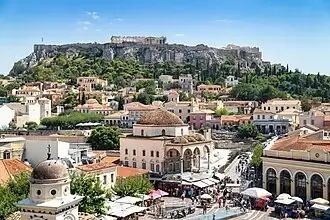
Two days is right for Athens. The Acropolis obviously, and ideally at opening time rather than at eleven when the cruise groups arrive. The Acropolis Museum afterwards, because seeing the sculptures and then looking out through the glass at the building they came off is the point of how it was designed.
What gets skipped, and should not be, is the National Archaeological Museum up in Exarchia. It holds the Mask of Agamemnon, the Antikythera mechanism and a bronze Poseidon mid throw, and on a weekday morning you can have rooms of it to yourself. It is the better museum. It just has a worse location.
Spend an evening in Anafiotika, the cluster of whitewashed island style houses built into the north slope of the Acropolis by Cycladic stonemasons brought in to build the royal palace in the 1800s. They built themselves a village that looks like home, and it is still there, three minutes from the tourist crush of Plaka and almost silent.
Pick the car up on your way out rather than on arrival. Athens traffic is not a pleasure and the metro does everything you need in the centre. Local suppliers tend to be significantly cheaper than the international desks, and you can rent a car in Athens without the large credit card hold that catches people out at airport counters. Start the hire the morning you leave and you save two days of parking charges.
Delphi, and why it earns the detour
Two and a half hours northwest of Athens, up the flank of Mount Parnassus, the ancient Greeks put the centre of the world. The sanctuary of Apollo at Delphi is built into a slope above a sea of olive trees running down to the Gulf of Corinth, and the setting does as much work as the ruins.
Walk up the Sacred Way to the temple, then keep going to the stadium at the top, which most people skip because of the climb. The museum below holds the Charioteer, a bronze from 470 BC whose inlaid eyes have survived intact, and which is worth standing in front of for a while.
Stay in Arachova, ten minutes away, rather than in Delphi village. It is a ski town in winter and a pleasant stone built place to eat in summer.
Meteora, where the schedule matters
From Delphi, a three hour drive north brings you to Kalambaka and the single most improbable landscape in Greece. Sandstone pillars rise up to 400 metres off the plain, and in the fourteenth century monks climbed them and built monasteries on top, hauling supplies up in nets. Six are still active.
The practical thing nobody tells you: each monastery closes on a different day of the week, and the schedule shifts between summer and winter. Check the current opening days before you drive up, or you will arrive at the one you most wanted to see and find the gate shut. Dress code is enforced, with skirts provided at the entrance for anyone in shorts.
Drive the loop road at sunset even if you have already visited. The light on the rock does something that no photograph has ever caught properly.
Pelion or Olympus, depending on what you want
Here the route forks and both options are good.
East, towards the coast, the Pelion peninsula is where Athenians go when they want mountains and sea in the same afternoon. Stone villages like Makrinitsa and Tsagarada sit in chestnut forest above beaches reached down absurd hairpins. Damouchari, a tiny harbour on the east coast, was used for the filming of Mamma Mia. There is also a narrow gauge steam railway that runs in summer between Ano Lechonia and Milies, built by the father of the painter Giorgio de Chirico.
North, the A1 runs along the foot of Mount Olympus. Litochoro is the base, and you do not need to be a mountaineer to get something out of it: the walk up the Enipeas gorge from the village, past the monastery and a series of pools, is a half day and gives you the sense of scale. At the mountain’s foot sits Dion, the Macedonians’ sacred city, a waterlogged archaeological park where you walk between excavated streets with frogs in the drainage channels.
Vergina, the detour most people have never heard of
Just before Thessaloniki, turn off towards Veria and the village of Vergina. Underneath a man made mound here, archaeologists found the royal tombs of Aigai, the old Macedonian capital, including the undisturbed tomb of Philip II, Alexander the Great’s father.
The museum is built into the mound itself, dark and cool, with the tomb facades lit in situ and the grave goods, gold larnax, armour, an ivory portrait head, displayed around them. It takes an hour, it is a UNESCO World Heritage site, and on most days it is quiet. For anyone who has just come from Delphi and Meteora, it supplies the chapter that connects the classical world to the Hellenistic one.
Thessaloniki, which is not Athens’s smaller sibling
Greece’s second city gets written about as an afterthought, which says more about guidebooks than about Thessaloniki. It is a port city with a Roman arch in the middle of a shopping street, a fourth century rotunda that has been a mausoleum, a church and a mosque, and an upper town, Ano Poli, that survived the great fire of 1917 and still has Ottoman houses leaning over cobbled lanes.
It is also, by broad agreement among Greeks, where you eat. The Modiano and Kapani markets, the bougatsa shops that open at six in the morning, the ouzo and meze places in Ladadika. The city has a large student population and a nightlife that starts far later than visitors expect.
Give it two days, and use them on foot. Then, if you want Halkidiki’s beaches or the wineries around Naoussa, rent a car in Thessaloniki for the days you actually need one rather than keeping a vehicle parked for a week.
The practical bits
One way rentals. This is the catch with the route. A car picked up in Athens and dropped in Thessaloniki is a one way hire, which the international chains handle with a supplement and smaller local suppliers often cannot do at all. Check before booking. The alternative many people prefer is to hire in each city separately for the legs that need it, and cover the long middle section by rail, which is cheap and scenic.
Tolls. The A1 has a string of toll stations and they add up. Keep cash and cards to hand, and note that the detour roads to Delphi and Meteora are toll free.
Driving culture. Greek drivers on open roads expect slower vehicles to move onto the hard shoulder so they can pass. It feels wrong the first few times. It is normal here and refusing to do it makes you the problem.
Timing. May, June, September and October. July and August are hot on the plains, and Meteora in particular becomes unpleasant in the middle of the day.